Does burning tokens create value? The BNB playbook and how Hyperliquid, Aster and Lighter copy it
Nine years ago Binance promised to spend profits buying back and burning BNB every quarter. Today the three largest on-chain perp exchanges do exactly that with trading fees — while Uniswap and Pump.fun also burn, but on a very different logic.
A token burn sends tokens to a "dead" wallet nobody holds the key to, or calls a destroy function on the contract, so total supply shrinks permanently. Burning creates no money; it simply divides the same business among fewer tokens. So the right question is not "does the project burn" but what money pays for the burn, how regular it is, and whether it outruns unlocks. BNB has answered all three for 36 straight quarters — which is why it became the template for today's wave of perp exchanges.
BNB: 36 burns, $18.3 billion, and a formula that needs no trust
Binance's 2017 whitepaper committed 20% of quarterly profit to buying back and burning BNB until supply fell from 200 million to 100 million. The first round on 18 Oct 2017 burned 986,000 BNB worth $1.31 million — under $1.40 per BNB. The 36th round on 15 Jul 2026 burned 1,615,828 BNB worth $931.7 million, about $577 per BNB. In total Binance has burned $18.3 billion — the industry's largest burn programme in dollar terms.
More important than the numbers is the mechanism change in late 2021. From Q4 2021 the burn no longer depends on profit Binance reports but on the public Auto-Burn formula: B = N × 150 / (P + K), where N is the number of BSC blocks in the quarter and P the average BNB price. The higher the price, the fewer BNB burned — but anyone can compute it before the announcement. In parallel, BEP-95 burns a share of gas fees every block. The result is a burn programme that does not require trusting the exchange's financials.
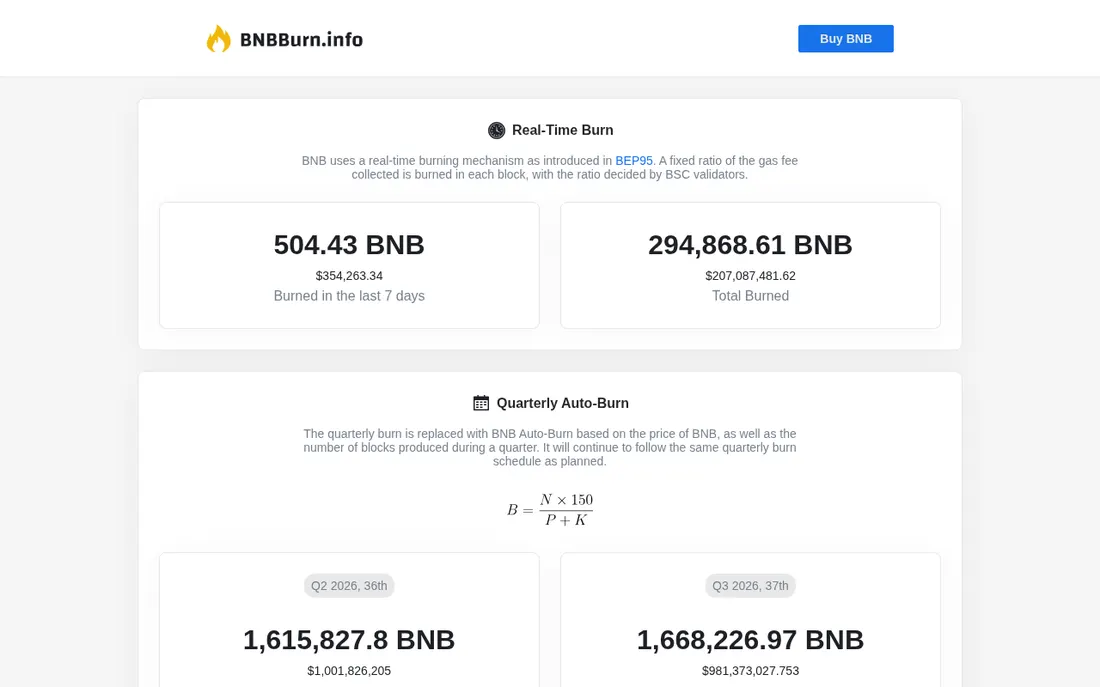
The BNB lesson fits in three points: burn money comes from a real business, the cadence is fixed and computable in advance, and burns exceed new issuance — all 200 million BNB were issued in 2017, so every BNB burned is a net supply cut. These are the three tests applied to the perp exchanges below.
On-chain perp exchanges copy the formula with trading fees
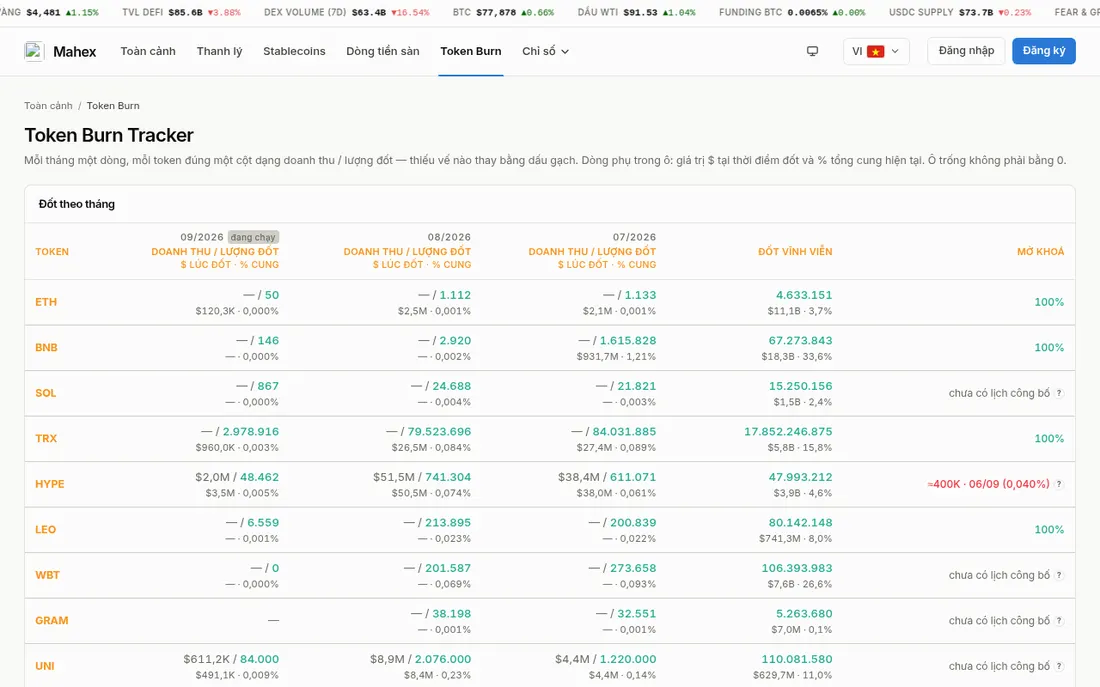
Perpetual-futures exchanges (perp DEXs) are the rare kind of dApp with large cash flow that can be measured daily. Hyperliquid, Aster and Lighter all route that fee flow into buying their own token and then burning or locking it permanently. The Mahex tracker puts them on one ruler: monthly revenue, monthly burn, and the counterweight — unlocks.
Hyperliquid (HYPE): a fund that buys every few minutes
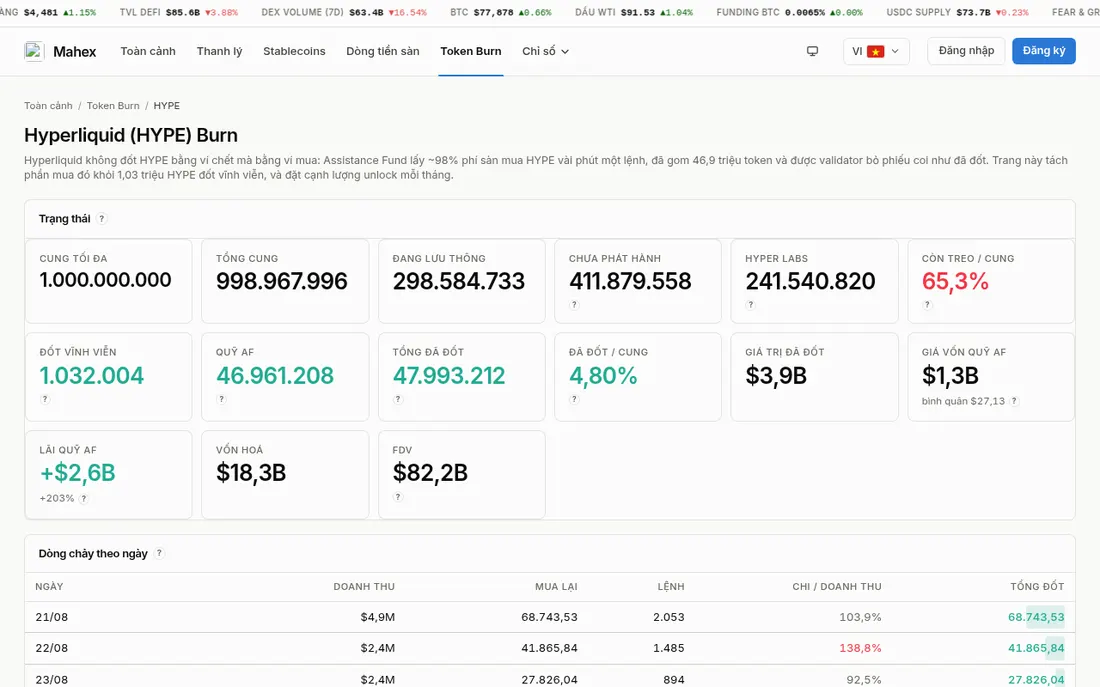
Hyperliquid does not burn HYPE with a dead wallet but with a buying wallet: the Assistance Fund receives roughly 97–98% of exchange fees and automatically buys HYPE on the market every few minutes. By 2 Sep 2026 the fund held 46.96 million HYPE at a total cost of $1.27 billion — an average cost of about $27, against a price of around $82 at the start of September 2026. Validators voted to treat the fund's tokens as removed from circulation; on top of that, 1.03 million HYPE has been burned permanently from gas and spot fees.
In August 2026 the Mahex ledger measured $51.5 million of revenue, and the fund spent $50.5 million buying 729 thousand HYPE — a spend/revenue ratio of 98%. Over the four months May–Aug 2026 the fund bought 3.2 million HYPE, about $194 million. The counterweight is the team unlock of roughly 400 thousand HYPE on the 6th of every month: the fund is buying 1.8 times the unlock. From 3 Oct 2026, the AQAv2 mechanism also uses interest on USDC reserves to buy HYPE — a second cash flow independent of trading volume.
Aster (ASTER): fee-funded buybacks, then burns from the team allocation
Aster — a perp exchange on BNB Chain — has burned 196 million ASTER, about 2.5% of the 8 billion max supply. But that figure blends two mechanisms. The first three seasons (Dec 2025–Feb 2026) were genuine buybacks: round #1 on 5 Dec 2025 burned 77.9 million ASTER ($79.8 million), round #3 on 5 Feb 2026 burned 98.4 million ($53.9 million). From 29 Jun 2026 Aster switched to burning every two weeks from the team allocation, matching the fees spent in the period; the five rounds #6–#10 total 18.25 million ASTER, with round #10 on 24 Aug 2026 the largest at 7.16 million ($4.8 million).
The second method still cuts max supply, but differs from BNB on the key point: the burned tokens come from an unissued reserve, not from sellers' hands, so circulating supply is unchanged. Aster's counterweight is also the largest of the three: 5.1 billion ASTER still locked, and 1.06 billion unlocked in the past 12 months.
Lighter (LIT): one round, one block, all of the revenue
Lighter, a zk perp exchange on Ethereum, chose the quarterly cadence closest to BNB's. Its first round on 10 Jul 2026 burned 15,638,702 LIT to a dead wallet at block 25,505,247, worth $37.5 million — all revenue from token launch to the end of Q2 2026, or 1.56% of the 1 billion max supply. Lighter's revenue comes from premium and institutional accounts, not retail traders, who pay no fees.
August 2026 revenue measured $3.18 million, so the Q3 round should be only about one tenth of the first in dollar terms (this ledger's estimate). The new counterweight is what to watch: 500 million LIT for the team and investors begins unlocking on 29 Dec 2026, about 3.19 million per week. At the current revenue pace, one quarter of Lighter burns is less than one week of unlocks.
Three perp exchanges next to BNB: who burns how much
The gap is still wide: one BNB quarter burns more than six Hyperliquid quarters, and Hyperliquid is three times Aster plus Lighter. But on spend as a share of revenue, the three perp exchanges are on the right playbook: Hyperliquid spends around 100% of fees, Lighter 100% of quarterly revenue, Aster burns the equivalent of fees used — whereas BNB in 2017–2021 spent only 20% of profit. What the perp exchanges still lack is time, and a fully issued total supply.
Uniswap and Pump.fun: also burning, but in a different direction
Uniswap (UNI): the DAO's fee switch, burning from the treasury
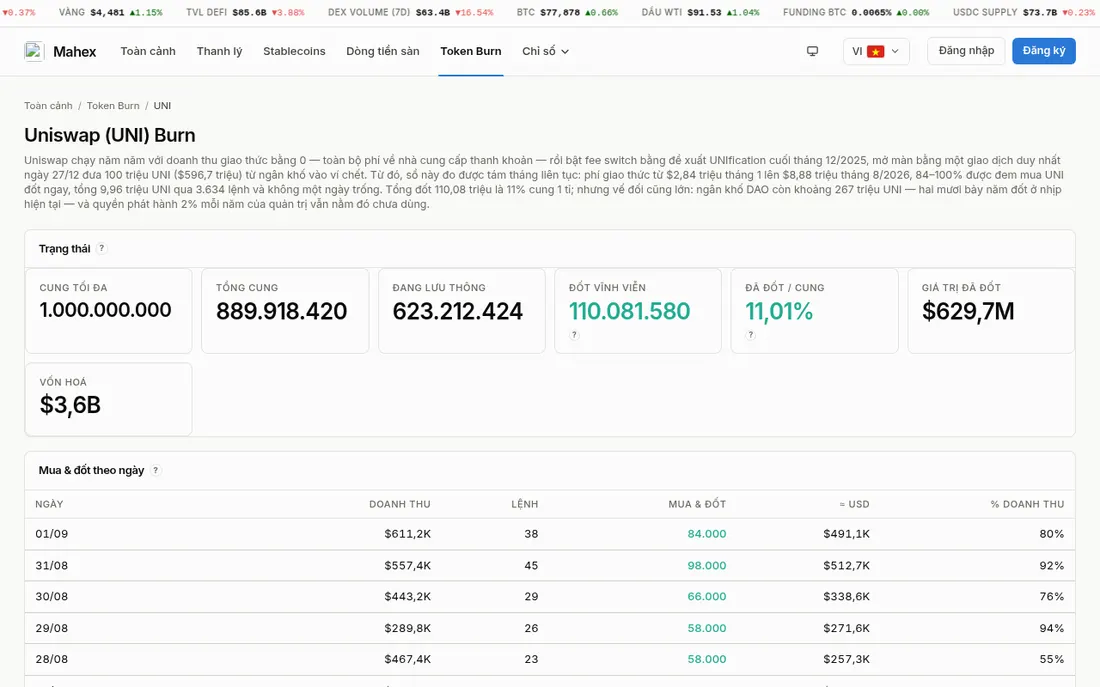
Uniswap ran for five years with zero protocol revenue — every fee went to liquidity providers. The UNIfication proposal in late December 2025 turned on the fee switch, opening with a single transaction on 27 Dec 2025: 100 million UNI ($596.7 million) moved from the treasury to a dead wallet as a retroactive burn. Since then the protocol's share of fees (5–12% of total LP fees) has bought and burned UNI continuously: 9.96 million UNI in the first eight months of 2026; in August 2026 alone, $8.88 million of revenue and 2.08 million UNI burned ($8.45 million). In total 110.08 million UNI has been burned, 11% of the 1 billion supply.
It differs from BNB in that this is a governance decision, not a company's commitment: the DAO can change the fee share, the treasury still holds about 267 million UNI, and the right to mint 2% more per year remains unused. Uniswap's burn depends more on votes than on fees.
Pump.fun (PUMP): a burn every few seconds, and one 128 billion lump
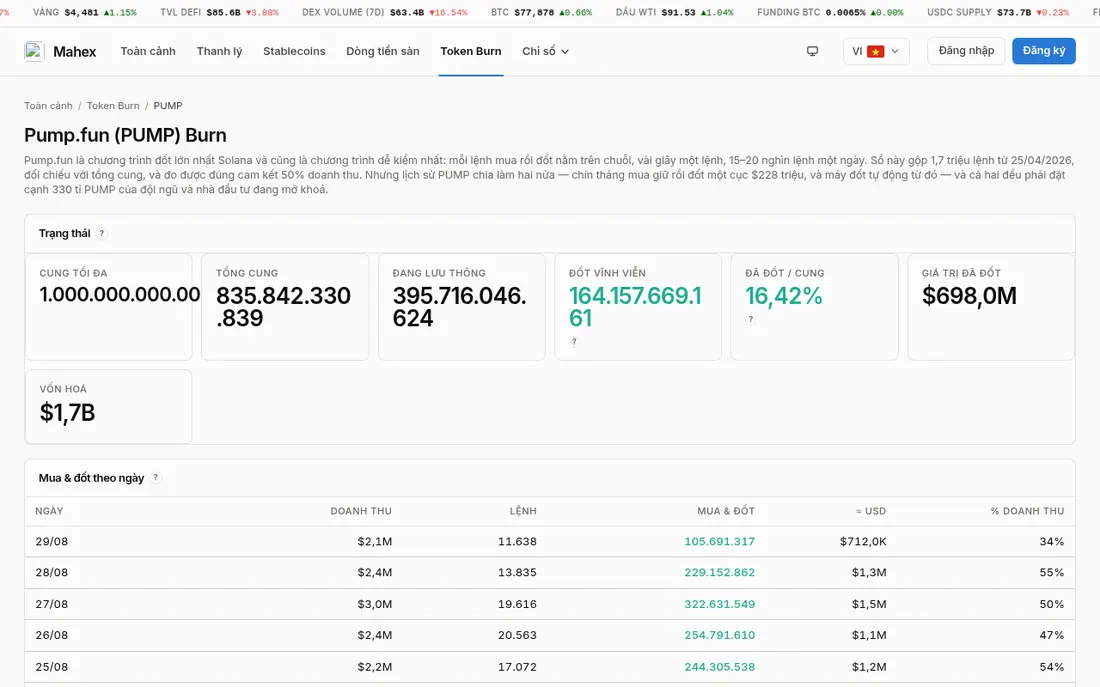
Pump.fun is Solana's largest burn programme and the easiest to audit: every buy-and-burn order sits on-chain, 15–20 thousand orders a day. For the first nine months revenue bought PUMP that was held, then on 28 Apr 2026 a single lump of 128.29 billion PUMP worth $228 million was burned. The commitment then changed from 100% to 50% of revenue, burned automatically: August 2026 revenue $52.6 million, burned $24.1 million — exactly 46%. In total 164.2 billion PUMP has been burned, 16.4% of the 1,000 billion supply, worth $698 million at burn time.
Pump.fun's different direction is burning to offset issuance rather than cutting net supply: 330 billion PUMP for the team and investors is unlocking at 6.875 billion a month until 2029. At the early-September 2026 price (about $0.0043), the monthly unlock is close to $30 million — slightly more than August's burn.
A burn is no guarantee of price — four things to check
- Where does the burn money come from? From fees paid by customers (Hyperliquid, Lighter, Pump.fun, Uniswap) or from an unissued token reserve (Aster since June 2026)? Only the first takes tokens out of sellers' hands.
- Burns versus unlocks? Hyperliquid buys 1.8 times its monthly unlock; Pump.fun burns roughly what it unlocks; Lighter is about to face 500 million LIT. BNB has no counterweight at all — its biggest advantage.
- "Burned" or "held"? 46.96 million HYPE sit in a fund, not a dead wallet; BNB's dead wallet also holds only 16.6 million of the 66.8 million burned, because most burns used a destroy call on the old chain. A burn ledger must measure the actual mechanism, not just read a wallet balance.
- Count in % of supply. $50 million a month sounds large, but for HYPE it is 0.07% of supply per month; BNB at the peak of its programme burned 1–2% of supply per quarter.